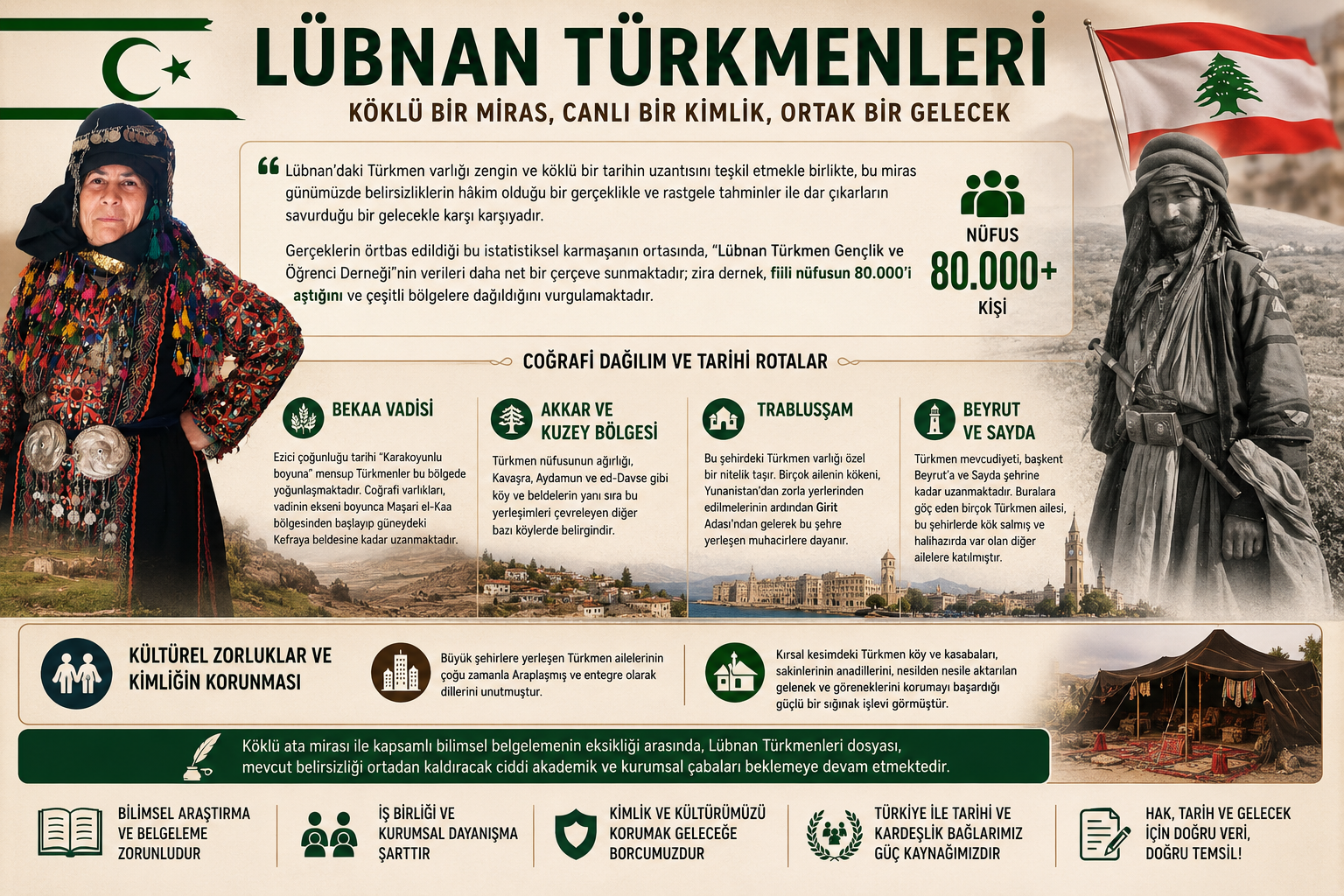
Lebanese Turks or Lebanese Turkmen: A Rich History, an Obscure Present and Future The Turkmen presence in Lebanon represents the extension of a rich and deep-rooted history, yet today, this heritage faces a reality dominated by obscurity and a future tossed around by random estimates and narrow interests. In the complete absence of any scientific, documented field research to count the Turkmen population and determine their actual areas of settlement, the issue of the Turkmen presence has devolved into an arena for speculation and random figures. This crisis is evident in the deliberate underestimation of numbers by some groups who confine the Turkmen identity to a very narrow circle, portraying themselves as the sole representatives in order to monopolize Turkish support. Compounding this obscurity is the refusal of some parties to cooperate with researchers, coupled with a scarcity of academics and specialists traveling to Lebanon to investigate this file. Together, these factors have obscured the facts and prevented an accurate, comprehensive understanding of their true demographic size and geographical distribution. Amidst this statistical chaos, data released by the "Lebanese Turkmen Youth and Student Association" puts things into perspective. The association confirms that the actual population exceeds 80,000 Turkmen, distributed across multiple regions including the Bekaa Valley, Akkar, Dinniyeh, Tripoli, Beirut, and Sidon. Geographic Distribution and Historical Routes Across the Lebanese map, this demographic presence is distributed according to specific historical and geographical trajectories: The Bekaa Valley: This region holds a concentration of Turkmen, the vast majority of whom belong to the historical "Karakoyunlu" tribe. Their geographical footprint extends primarily along the valley, starting from the Masharih al-Qaa area in the northern Bekaa down to the town of Kefraya in the south. Akkar and the North: The Turkmen demographic weight is prominent in villages and towns that have actively preserved their identity, such as Kouachra, Aydamoun, and Al-Dousa, in addition to several surrounding villages. Tripoli: The Turkmen presence here takes on a unique character. The origins of many families trace back to immigrants from the island of Crete, who settled in the city following their forced displacement by Greece. Beirut and Sidon: The Turkmen presence extends to the capital, Beirut, and the city of Sidon. Many migrating Turkmen families settled here, joining other families that were already deeply rooted in these coastal cities. Cultural Challenges and Identity Preservation Despite this widespread presence and deep-rooted history, the Turkmen face varying socio-cultural challenges. Over time, the majority of Turkmen families who settled in major cities became Arabized, assimilating into their surroundings and losing their mother tongue. In contrast, rural Turkmen villages and towns have served as strongholds, allowing their inhabitants to successfully preserve their native language, customs, and traditions passed down from generation to generation. Caught between an authentic ancestral heritage and a lack of comprehensive scientific documentation, the file of the Lebanese Turkmen awaits serious academic and institutional efforts to dispel the current obscurity and preserve the history and rights of this essential component of Lebanon's social fabric.
Lebanese Turks or Lebanese Turkmen: A Rich History, an Obscure Present and Future
Summary: Caught between an authentic ancestral heritage and a lack of comprehensive scientific documentation, the file of the Lebanese Turkmen awaits serious academic and institutional efforts to dispel the current obscurity and preserve the history and rights of this essential component of Lebanon's social fabric.